The Service
It was February 11, 1940, a gloomy, wet Sunday night. The parishioners of Irondale Assembly of God were singing along with the plunky, out-of-tune piano, played faithfully by Sister Dotson.
“There is power, power, wonder-working power in the blood (in the blood) of the lamb (of the lamb!)” the congregation sang, their voices rising and arms reaching toward the sky. Reverend R.C. Wetzel began to bring the service to a close, making an alter call and asking for prayer requests.
“As we close tonight’s service, I’ll ask for anyone with prayer requests to come forward,” he said. Redbud Pyatt, a respected elder of the church, his face etched with the years of hard labor, approached the pulpit. His voice was heavy as he spoke of his five-year-old grandson, Oscar, who lay at home, bedridden with fever and dangerously close to death. The boy had come down with whooping cough, which had worsened into a severe case of pneumonia.
The congregation prayed fervently as the song shifted to: “He’s under my feet, he’s under my feet! Satan is under my feet!” Reverend Wetzel, his voice strong with conviction, continued preaching. “Satan is a sly one,” he warned as the church swayed in prayer. “He comes in the form of a snake, bringing sickness and evil upon our children. But God is almighty! Amen?”
The congregation responded loudly: “Amen!”
“And didn’t God say, ‘I have given you authority to trample on snakes and scorpions and to overcome all the power of the enemy; nothing will harm you’?” Reverend Wetzel continued. “Let us pray for God’s little child tonight, and may we strike this illness from his body in the name of the Almighty!”
The room thrummed with the powerful energy of the Holy Spirit, voices rising in unison as they prayed for young Oscar’s recovery, lifting him up in their faith and hope.
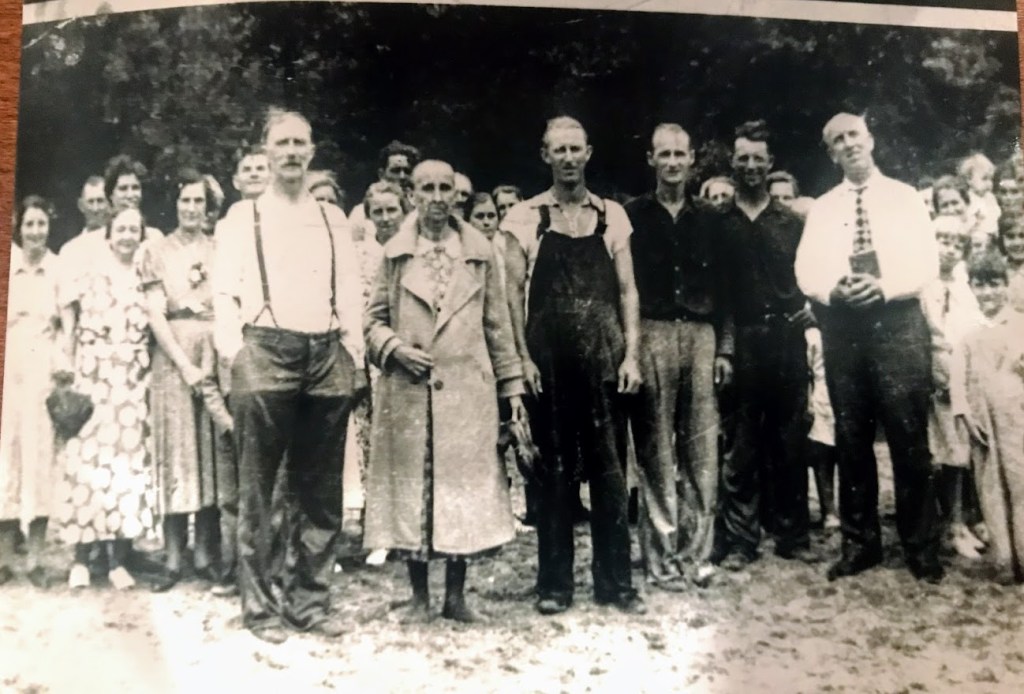
Above: Mary with the congregants of Irondale Assembly of God
The Prayer Meeting
When the service ended, a few parishioners offered to go back to the house where Oscar was staying to pray over him directly. They crowded into the small bedroom, where Brother Arvel led the quiet prayers. A few of the women laid hands on the boy as he coughed and struggled to catch his breath, while some of the men began to work themselves into a fervor of prayer.
It was an eerie moment when, one by one, the adults became aware that Oscar’s grandmother, Mary Pyatt, had risen to her feet. She stood straight and tall, her face radiant, glowing with a serene, almost divine beauty. She turned to the boy’s mother Pearl and, with firm conviction, said, “STOP.”
As one, the group fell silent and turned toward her. “I have a prophecy,” Mary declared. At Irondale Assembly, the women were known for their powerful and accurate prophecies—seen as divine messages delivered through faithful servants. The adults in the room took note. Mary spoke again, her voice clear and unwavering: “Oscar will not die, for God has told me that He has chosen him to preach the Gospel.”
The women in the room wept with relief, and the men all cried, “Amen!” in encouragement. But then Mary continued. “Wait,” she said. “God says He will take one other person in this room in Oscar’s place, so that he can continue his work on this Earth. But do not be afraid, for Oscar will change many lives.”
The group dispersed, their mood somber but filled with a quiet faith. Oscar slept peacefully that night, unaware of the weight of the prophecy that had just been spoken over him—nor that in three days, it would be Mary herself who would pass, fulfilling her own words.
The Prophet’s Call
Mary Tinker was no ordinary young woman. Life in Washington County, Missouri, where she had been born in 1879, was harsh and unforgiving. The rugged Ozark Plateau region, though rich in lead and timber, demanded backbreaking labor from its residents, who often faced lives marked by physical toil and isolation. Yet, for those living in the area, faith provided both refuge and purpose. The Irondale Assembly of God church was the spiritual heart of the community, and it was there that Mary found solace, becoming a woman known not just for her strong devotion to family, but also for her prophetic gifts.
Born into the Tinker family, Mary’s life was shaped by the Pentecostal roots that ran deep in her family and community. From a young age, she was drawn to the powerful worship and prophecies that filled the small wooden church, learning to navigate the line between the physical and the spiritual. Her faith was her anchor in a world that often seemed filled with uncertainty.
Following the customs of the time, Mary married young at the youthful age of 15. Her groom was Pleasant Monroe Pyatt, better known as Redbud, a man who shared her connection to faith and hard work. The days leading up to their wedding were frantic—her parents, Allen and Rebecca, hurriedly signed the consent for a justice of the peace, while Redbud made the living arrangements. But it wasn’t the pace of events that troubled Mary. Instead, she was disturbed by the visions she had been receiving, flickering images and whispered words that felt more powerful than anything she had experienced before.
Mary had only recently begun paying attention to the women’s prophecies at church, but already she felt that God was speaking directly to her. The visions came as flashes—brief, unsettling glimpses of what was to come. And the most recent one was terrifying. In it, she saw a dark, wild animal stalking her mother, Rebecca, who was riding on horseback. The vision was so vivid, so urgent, that Mary whispered her fears to her siblings. But they told her to keep it quiet. After all, strange feelings and prophecies could unsettle a family, especially in the days leading up to a wedding.
The wedding itself was brief, a simple exchange of vows, followed by promises to celebrate together at the church later. As Mary and Redbud arrived at the church, they were in good spirits, but Mary’s joy began to erode into unease as the minutes ticked by. Her mother, Rebecca, was late. Far too late. The feeling of dread she had carried for days tightened in her chest.
Rebecca Willis Tinker, riding back to the church on her horse, had been attacked by panthers and killed. Mary’s first prophecy had come chillingly true. The joyful celebration of her marriage was forever marked by the tragic loss of her mother—a moment that would define Mary’s life as both a bride and a woman of divine vision.
A Life of Prophecy
As the years continued, Mary made a life for herself in Dent, raising eight children and providing faithful leadership to the people of the church. Her prophecies weren’t just miracles, they were an ongoing part of her children’s lives. She created a rhythm around housework, church life, and doling out advice to those around her.
Mary’s first few prophecies after her mother’s tragic death were centered on family, perhaps born from a lingering sense of guilt or an attempt to make sense of the senseless. It was during this time that she began speaking of “the ties that bind us,” a phrase that became almost a mantra in her household. She reassured her children that God was carefully constructing their family with a lasting legacy, a legacy that would reach beyond the present generation. As Mary’s children grew older and the timber industry began to thrive in the region, many of her sons became railroad tie makers, harvesting wood for the expanding railroads. They couldn’t help but marvel at the uncanny symbolism of their mother’s words. What began as a spiritual prophecy about family connections soon took on a tangible form, as they worked daily to fashion literal ties that would bind the nation’s railways together. Mary’s ability to weave these connections—both spiritual and practical—left her family in awe of her foresight, reinforcing the belief that God was guiding their every step, even in the most unexpected ways.
One day, when her daughter Pearl was preparing to embark upon her own marriage, Mary took her hands. “Pearl,” she said gently. “God has shown me your hands—they will heal and nourish. With each meal you prepare, you will feed not just the body but the soul. Your knowledge of the earth’s remedies will bring comfort and healing to those in need. Many will come to your table, and in their hunger, they will find both peace and restoration. Your legacy will be one of healing, through food and faith.”
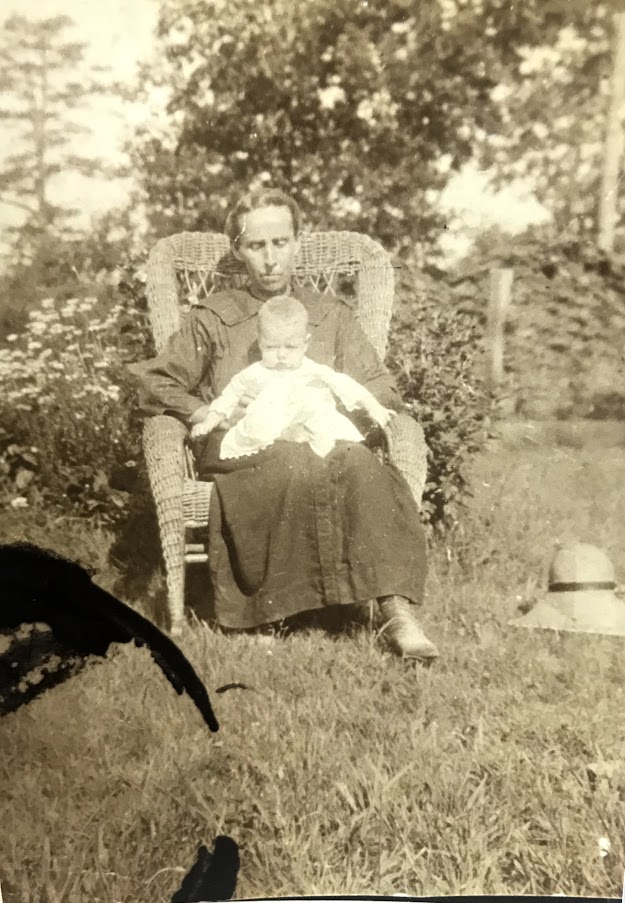
Above: Mary with her daughter Cora
The Final Prophecy
But it was Mary’s final prophecy that was perhaps the most impactful. Mary’s final prophecy, delivered in the tense, sacred air of her grandson Oscar’s sickroom, carried the weight of life and death. As she declared that Oscar would not die, that he was chosen by God to preach the Gospel, a sense of relief washed over those gathered. But when she added that God would take someone else in the room in exchange for Oscar’s life, the mood turned somber.
The days after the prayer meeting were filled with a strange quiet, as though the family and church were holding their breath. Oscar, to nobody’s surprise, began to recover. His fever broke, and his labored breathing eased. But the family couldn’t help but wonder who the prophecy would claim. Then, just three days later, Mary stepped outside, as if drawn by some invisible force. She walked to the edge of the woods behind her home, where the trees stood tall and dark in the fading light.
As she moved through the underbrush, a sense of déjà vu washed over her, and suddenly, she saw it: a snake slithering across her path. Her mind flashed back to Reverend Wetzel’s sermon. “Satan comes as a snake,” he had said. “But God has given us the power to trample them underfoot.” Acting on instinct, she lifted her foot and brought it down hard on the snake, crushing it beneath her.
But as the snake writhed and stilled, Mary stumbled. A sharp pain shot through her body, and she grabbed futilely at branches as she fell to the ground. There, in the quiet woods, surrounded by visions of the land she had spent decades nurturing, her final breath came softly, like a whisper in the wind. The prophecy had been fulfilled. Oscar would live, but her time had come.
The family would forever remember her as the woman whose faith had shaped their lives, whose visions had guided their paths, and whose final act had brought them all closer to God. The ties that bound them, both physical and spiritual, remained strong, woven together by Mary’s unwavering belief in God’s divine plan. She left behind a legacy not just of prophecy but of courage, love, and a life lived with purpose.
Coda: This story is embellished but based on actual stories passed down in the family, some of which can be read in Oscar Barton’s book “Angels Never Die, They Just Fly Away.”


 My Kindred Chronicles
Leave a comment