
The Writer
The sun streamed through the iron-framed windows of the print shop, casting bright rays where tiny swirls of dust danced in the air. At his workbench, Herman sat, mentally composing a letter to his brother. The familiar, stale scent of the shop lingered—a bitter tang of black ink that seemed to cling not just to his fingers but to his very breath. Herman didn’t mind; the printing press felt like a more civilized kind of work than he was used to, and it thrilled him. Yet, he knew he’d have to sell this new path—not to the public, but to his own family. He just needed to find the right words to express that feeling in his letter. He pulled out a fresh sheet of paper, dipped his pen in ink, and set to work.
Dear Fritz,
I have taken up the use of the printers here in Des Moines to pen a letter to you, as my thoughts have often turned to you and our days on the farm. I think back to those endless rows of crops where, under Father’s instruction, we worked in the old ways he and Mother brought from Flekkefjord. Did you ever feel as I did, I wonder, that those fields were more than just soil? They were our training ground, a foundation that has carried us toward a better life in these new states.
Yet, I feel an undeniable pull toward something beyond the parochial life of our parents. Since attending school at Drake, I’ve experienced an awakening to the possibilities of a life devoted to community building through the written word and oration. My hands have grown more accustomed to setting type than digging earth. And with every letter I arrange on these pages, it becomes clearer: I am drawn to words and ideas, as you are to the cattle, as Otto is to his trade. This print shop—these blank pages waiting to be filled—offers a future as open as the country itself, and one I believe is mine to make.
I shall leave the tilling of earth to stronger hands, for my reach lies here. I write to you, Fritz, with the hope that you’ll understand my journey, just as I have come to understand yours.
With my sincerest affection,
Herman
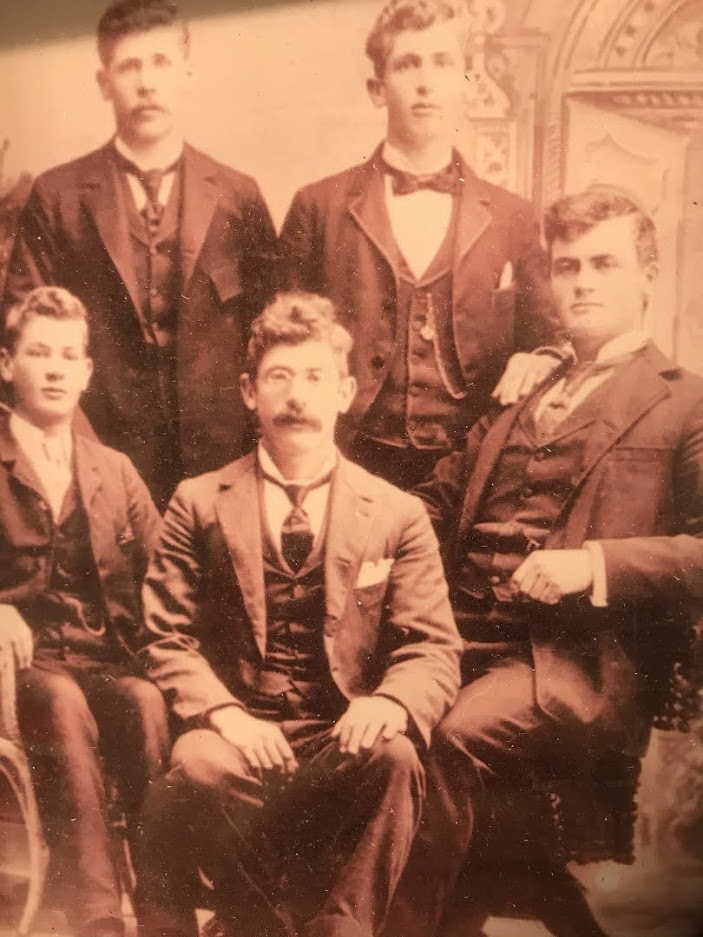
Above: Herman (right) with his brothers.
Salesmanship in Print
Olger Herman Oleson, known to family simply as Herman, was born in Iowa in 1874 to Norwegian immigrants Jacob and Frederikka. Growing up as one of five sons—Otto, Martin, Fritz, and Hartwick—he learned farming trades and carpentry from his father. Yet, as a relative once noted, “Herman was inclined to study and read, and not inclined toward manual work.” Herman’s academic pursuits took him to Humboldt College, followed by law studies at Drake University, where his curiosity expanded into civic matters and law, further widening his view of the world.
In November 1900, with financial help from his father, Herman purchased his first newspaper, the Bode Bugle in South Dakota. Though it was a small operation with print machines worn by years of use, Herman saw it as the beginning of a grand endeavor. He threw himself into the work, setting ambitious goals to establish newspapers across the burgeoning Midwest. For Herman, these papers were more than a business—they were a means to connect with communities, champion local causes, and give voice to the often unheard.
It wasn’t long before Herman gained a reputation as a community-centered and ethically driven publisher. The press frequently praised him for producing a paper that was “a credit to this community” and recognized his dedication to involving and informing the public. His commitment to quality extended to his views on advertising, which he described as “salesmanship in print”—capturing his conviction that a newspaper should bridge businesses with the communities they serve.
This dedication soon caught the eye of Judge James P. Connor, a prominent Iowa figure who appointed Herman as his personal secretary. Through this role, Herman stepped into new social circles, deepening his commitment to public service. Balancing both publishing and politics, Herman sharpened his skills as a writer and advocate, laying the foundation for a career devoted to the community and ideals that would define his life.
The Nebraska Journal-Leader
Ponca, Nebraska; Thu, Oct 12, 1911
Greeting
I have purchased the Northern Nebraska Journal, and have already taken possession by proxy. I expect to be on hand in person about the time this issue reaches its readers.
Having published newspapers at various points during the past fifteen years, I take up the work here, with some knowledge of newspapering and sufficient experience to enable me to publish a creditable newspaper. This I propose to do. I believe the people of Ponca and Dixon County are loyal to their home paper, and that they find it well worth while to support it at every opportunity.
A newspaper is a semi-public enterprise, and depends for its best success upon the good will and cooperation of the people. I therefore solicit the friendship and cooperation of the people of Ponca, and vicinity. I believe that if I have that I can issue a paper that shall be a credit to this community. A good newspaper is an important factor in the prosperity and reputation of any town or community.
I wish to be informed of all happenings that may be of general interest and importance. Do not wait for an introduction but remember that we all belong to the same republic and the same brotherhood of humanity and so consider that we need no further introduction.
The favorable impression that I have received of Ponca and Dixon County Nebraska prompted me to get possession of the Journal. I consider this a desirable location both socially and from a business standpoint. I believe that time will vindicate this opinion.
Respectfully yours,
O.H. Raleigh
Personal Reinvention
In 1907, Herman and his brothers made a mutual decision to change their family surname. “There are too many Olesons in the neighborhood!” they complained—a fair point given the numerous Norwegian families settling in the Midwest. The tradition of surnames reflecting the father’s first name, while honoring their heritage, was increasingly impractical in the growing Norwegian communities. Herman, especially, was frustrated by postal mix-ups and saw an opportunity to rebrand himself for the public stage. Adopting an English name, he believed, would help him step beyond his farm roots and into a more cosmopolitan image.
From then on, Herman became known as “O.H. Raleigh” to the public – a name he crafted carefully to sell himself, to capture attention and project authority. As Judge James P. Connor’s secretary, he maneuvered through the political circles of Iowa’s government with a newfound sense of purpose. His salesmanship would now extend beyond the printed word to his political reputation. But his outspoken nature and his immersion in legislative affairs soon sparked intense friction with the Judge. Their eventual split was nothing short of dramatic, peppered with veiled insults and scathing editorials Connor’s allies published in the very newspapers Herman managed. With a wry sense of pride, Herman printed the insults boldly, standing by his belief that citizens should speak openly—even if it invited conflict.
Herman’s dissatisfaction with political complacency, particularly Connor’s ambitions for multiple terms in office despite legal restrictions, fueled his critiques. This became the foundation for his public stances, leading to his famous condemnation of Congress as “a couch for the repose of languid ambition.” After parting ways with Connor, Herman redirected his energies to support Connor’s rival, the progressive Frank P. Woods, using his editorial talents to rally public support and sharpen his voice in the political arena.
While navigating politics and publishing, Herman also ventured into real estate, leveraging his community knowledge from the newspapers to build a customer base. This business offered him financial stability and a degree of independence, allowing him to speak and write with greater freedom, unbound by patronage or favor—a freedom that defined the next chapter of his life.
The Denison Review
Wed, Apr 29, 1908
RALEIGH-BORN OLSON
O. H. Raleigh, née Olson, known throughout the district as the man who changed his name for fear someone would think he was a Scandinavian, was a Denison caller last week. Mr. Raleigh, née Olson, is now engaged in the delectable task of promulgating falsehoods about the man, who out of pity for his incapacity retained him in a lucrative position long after his utter uselessness was apparent. So late as last spring Mr. Raleigh née Olson came to Denison to beg Judge Conner to take him to Honolulu with him, and at that time he protested his undying friendship for his benefactor. It must be a relief to the honorable family tribe of Olsons, that Olger has repudiated them and that his effeminate smile now answers to the truly English name of Raleigh. But it is enough to make the ghost of Sir Walter rise up in vengeance.
Highs and Lows in the Midwest

Above, Herman and his wife Alma
Amid the celebrations and ambitions of his public life, Raleigh faced profound personal joys and losses. He married Alma, a young woman from the Norwegian Lutheran community who shared his studious nature and charm. She brought him a sense of joy and a shared commitment to travel and build their newspaper ventures across the Midwest. Yet, despite their aspirations, their brief marriage was marked by hardships. Their first infant daughter passed away within weeks of her birth, and shortly after, a fire destroyed Raleigh’s printshop, wiping out the business they had poured their energy into. Searching for peace and a fresh start, they moved to Minnesota, setting up a new paper and, for a time, living what seemed to be the American dream. They welcomed a son, Stanford, and a daughter, Ruth, filling their lives with hope and purpose.

Above, Herman with Alma and his oldest children
But tragedy struck once more when Alma fell suddenly ill and passed away in a Chicago hospital, leaving Raleigh alone to raise their young children. The grief that followed, compounded by the near-simultaneous deaths of his brother Martin and his mother Frederikka, left him scrambling for an emotional foothold. Amid this turmoil, he found solace in Alma’s sister, Annie, whom he soon married. Together, they chose a more permanent life in Palo Alto, Iowa, where Raleigh accepted a position as postmaster. This role gave him a renewed sense of community and stability—a stable foundation from which he could rebuild.
Evening Times-Republican
Sat. May 27, 1911
Special to Times-Republican.
Webster City, May 27.—The political pot in the big Tenth congressional district is beginning to sizzle. Congressman Frank P. Woods, who is just now completing his second term, has not yet announced his intentions as to the third term. Close friends of his say, however, that when he returns home to Estherville upon the close of the special session he will make due announcement to the voters of his intentions to again be a candidate.
Senator Joe Allen, of Pocahontas, is looked upon by many as a very likely candidate. Senator Allen was in Webster City in attendance upon the annual session of group two of the Iowa State Bankers’ Association. Approached by a newspaper man, Senator Allen disclaimed like never before any political wisdom. Asked directly whether he would or would not be a candidate for congress from the Tenth district, Senator Allen said he had not yet made up his mind. “But in any event,” he said, “I would do Congressman Woods the courtesy not to announce it until his return to the state.”
Announcement Is Expected.
There is every reason, however, to believe that the big senator from Pocahontas is casting a serious eye over the situation. O. H. Raleigh, of Estherville, a former warm supporter and private secretary to Congressman Conner and later a warm supporter and private secretary to Congressman Woods and last winter an assistant clerk in the Iowa senate, is making a quiet trip over the Tenth district with his ear to the ground. He always says a good word for Senator Allen’s qualifications and that he is playing the “role of a John the Baptist, going before and preparing the way for the announcement of Allen in the interest of the candidacy of his chief.”
Resilience and Connection
From Palo Alto, Herman continued to manage his newspapers, staying engaged with the communities he’d connected with over the years. Along with his work in the Iowa Legislature, he supplemented his income with real estate insurance sales and tax assistance offered from his own home. Through these years of personal loss and professional adaptation, Herman’s commitment to family, Lutheranism, and service remained steadfast. Even as life threw challenges his way, he held true to the principle that had always guided his work: that, whether in print or in sales, resilience and connection were at the heart of a life lived with purpose.
Letter to the Editor
To the Esteemed Readers,
In this ever-changing world, where the tides of fortune ebb and flow and every season seems to bring its own challenges, I have often found myself contemplating the meaning of a life well-lived. What purpose can one serve that lasts longer than one’s own years? The answer, I believe, lies in the connections we forge and the principles we stand by, regardless of the path we walk.
Many of you know me through the pages of these newspapers. For years, I have made it my life’s work to bridge the voices of our community with the world around us, to give a platform to the ideas and people shaping the places we call home. My efforts may seem simple—a word on the page, an opinion given freely—but they are born from a belief that true “salesmanship” lies not in profit, but in service. It is not enough to make a living; one must strive to make a difference, however modest, however small.
The press has been my stage, my platform for amplifying the voices of our towns, for advocating the causes worth our loyalty, and for challenging the complacency that so easily sets in. This work is my “salesmanship in print”—a belief that words, purposefully used, can rally, unite, and inspire. My hope is that each of you, in your own lives, will take to heart the idea that what we leave behind is not merely a profession, but a legacy of service, of conviction, of an unyielding commitment to those ideals that shape our character.
So, as I write this, perhaps my last word to you in this forum, I urge you to consider: How will you use the tools at your disposal to leave the world a better place? Whether in the printed word, in the kindness of your actions, or in the honest labor of your hands, let your work reflect a purpose greater than oneself. May we all aspire to a life of salesmanship—in print and beyond—that leaves a mark of integrity upon this world.
Yours in purpose and in service,
O.H. Raleigh
Coda: This story is embellished but based on actual stories passed down in the family and from the hundreds of articles that O.H. penned his name to over his lifetime.
 My Kindred Chronicles
Leave a comment