
Chorus
Oh, Brushy Creek, where Legends grow
Where faith and folklore ebb and flow
With potter’s clay you build them all
To follow their ancestors’ call
Verse 1
In the Ozark Hills by Brushy Creek
A young boy played whose roots ran deep
A child with parents of Cherokee blood
Who taught him the ways of the land and wood
Verse 2
A Winchester rifle he called his friend
And hounds that he led to the riverbend
In the woods he played and hunted and strolled
And felt there a passion for stories told
Chorus
Oh, Brushy Creek, where Legends grow
Where faith and folklore ebb and flow
With potter’s clay you build them all
To follow their ancestors’ call
Child of the Hills
The green hills of the Ozarks aren’t just good for growing Dogwood and PawPaw trees…they also grow legends. And in my family, there are hardly more fascinating legends than that of the Reverend J.T. Barton – the preacher who walked the hills with a bible in his hand and a song in his heart.
Born of Cherokee blood in 1865 to George and Catherine Barton, whose family had been forced along the Trail of Tears, J.T. learned early to straddle two worlds – embracing the wilderness for its wild gifts while making his way in the broader community as a spiritual leader. By morning, he could be found out along Brushy Creek with his pack of hunting hounds and his repeating Winchester rifle, the first of its kind in the area. He would hunt deer most of the day, earning a reputation as a talented huntsman, “killing running deer as easily as if they were still” the locals said.
By evening, he returned to the modest farm where he lived with his parents and some of the fourteen siblings who had not yet grown up and moved on. He was especially close to his sister Polly Ann, and together they would sit for hours strumming a guitar and spinning songs to go along with the tales their parents shared. Mostly they sang about local folk tales like Jesse James and the Devil in the Hills, but sometimes his mother Catherine would tell him Cherokee stories – the Little People who lived in the forest or the Raven Mocker Witch who would go to the death bed of the sick and take out their heart to eat and steal the life within. Even as a boy, JT Barton was learning the power of stories and the strength of his roots, and one day, those tales and that faith would make him a legend in his own right.
Verse 3
With J.T. grown, he found a wife
Young Annie Camden bound for life
They farmed their land and raised some young
Off to Montana, so far-flung
Verse 4
They roamed the plains with weary hands,
And worked the unforgiving lands.
Yet JT’s heart began to yearn,
For old-time religion he could learn.
Chorus
Oh, Brushy Creek, where Legends grow
Where faith and folklore ebb and flow
With potter’s clay you build them all
To follow their ancestors’ call
A Couple’s Adventure
J.T. was a vocal and enthusiastic young man, so it was no surprise when he caught the eye of Annie Camden, a sturdy girl who wasn’t afraid to put in the same hard work the men work doing. Annie was as rooted in the land as J.T. was in the hills, and the two made an easy, natural match. Annie’s family home was down by Brushy Creek, a serene spot with the gentle sound of the nearby water and breezy tree limbs – it was a fitting place to have a wedding. In October of 1887, family and friends gathered by the creek as Annie’s father George gave his blessing for the union to the minister, Samuel Black. With good wishes and endless potential, they settled into life together as young farmers.
On their farm, they worked side by side, JT respecting Annie’s insistence on doing her full share. “I’ll have none of this homemaker nonsense,” she would say, refusing to let pregnancy slow her down as she tended cattle, chickens, and fields, planting and harvesting with determination. But in the late 1880’s, a whisper of an opportunity drifted their way – westward in Montana, land was cheap and plentiful if you were willing to work at it. J.T. and Annie weren’t scared of a hard day’s labor, and so they packed up their modest belongings and struck out for the frontier.
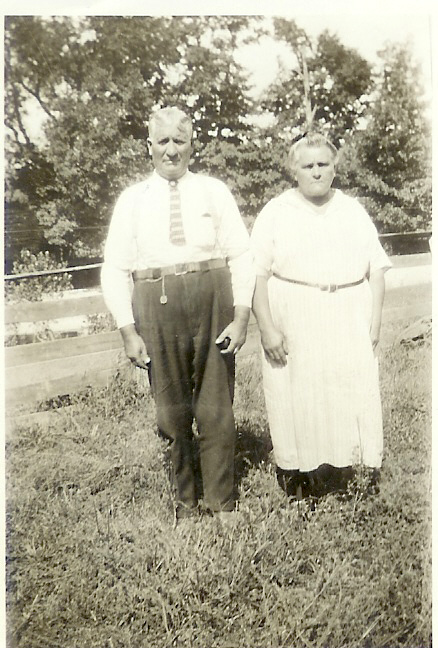
The wild, sweeping landscape of Montana suited the couple, but they found the work more challenging than they’d anticipated. Annie had another baby, and then another, and soon farming the unforgiving northern soil began to seem an impossible task. Discouraged, J.T. reached each night for the family bible, drawing comfort from the stories he’d known since he was a child. The days were long and back-breaking, but the evenings spent around the fire, recounting tales of the Ozarks and Cherokee legends to the children were the best parts of his day . Little by little, too, he began crafting sermons from the bible – it was filled with characters as bold and colorful as the folk heroes he had grown up singing about.
The pull of home was growing too strong to ignore. J.T. was beginning to realize that his heart belonged in the Ozark Mountains, and more than that, he was feeling an urge to channel his gift for storytelling into a more exciting purpose. He’d heard some local preachers when he was young, and he began to wonder if he could bring the same kind of energy to evangelism as the ministers back home.
And so it was that J.T. and Annie sold their Montana homestead and made their way back to the Ozarks. As the century turned and the 1900s arrived, they settled on a patch of land near Black River in Reynolds County where they could manage a smaller farm and J.T. could finally try his hand at preaching. Bit by bit, J.T. Barton – once a hunter, once a farmer – was now growing into something else – a preacher with a passion for the bible and a natural ability to tell stories with flair.
Verse 5
Now J.T. was a man of God
And preached the Word to all who trod
The brushy arbors built around
The sacred Ozarks holy ground
Verse 6
JT preached the whole nights through
And sometimes wrote a tune or two
Revival voices sang along
And filled the nights with worship strong
Chorus
Oh, Brushy Creek, where Legends grow
Where faith and folklore ebb and flow
With potter’s clay you build them all
To follow their ancestors’ call
Preaching and Singing
The 1920’s were roaring in the Ozarks with the hum of motor vehicles, the steady construction of roads, and the endless mining of resources. J.T. felt swept up with the energy of the rapid changes. In 1924, he was elected as an evangelist for the Bethel Association of United Baptists, and he spent the next, best years of his life preaching and singing with the congregants of the various churches of Missouri while his eleven kids had adventurous, free-spirited childhoods of their own. In Flat River, Farmington, Buick, and other such wild places, he constructed brush arbors (simple outdoor structures) and preached into the night for weeks at a time. He never took a salary, just offerings, and kept the revivals going as long as people continued to come. One revival, they said, “started when the cherry trees were in bloom and continued until the cherries were ready to be canned”. These gatherings were known far and wide, not just as spiritual awakenings but also as a lifeline to a community seeking ways to connect with one another.
J.T. found endless inspiration in the stories and struggles of the church community, and often wrote songs about the stories he heard from the pulpit. One night, a stressed-out looking woman approached him at the end of the service, her face tear-streaked. She asked if he could have everyone pray for her little girl, who had gone missing in the night. J.T.’s congregation joined in fervent prayer and a few of the people put together a search party. By morning, the girl was found and brought home safe to her family. Moved by the sorrow, fear, and ultimate joy of the family, that very day he penned “Little Alice Summers” to commemorate the ordeal. The song quickly became a popular tune and was sung all around the region for years to come. It gave J.T. so much happiness to hear his song making its rounds, and thus encouraged by the success, he began to look around for more source material.

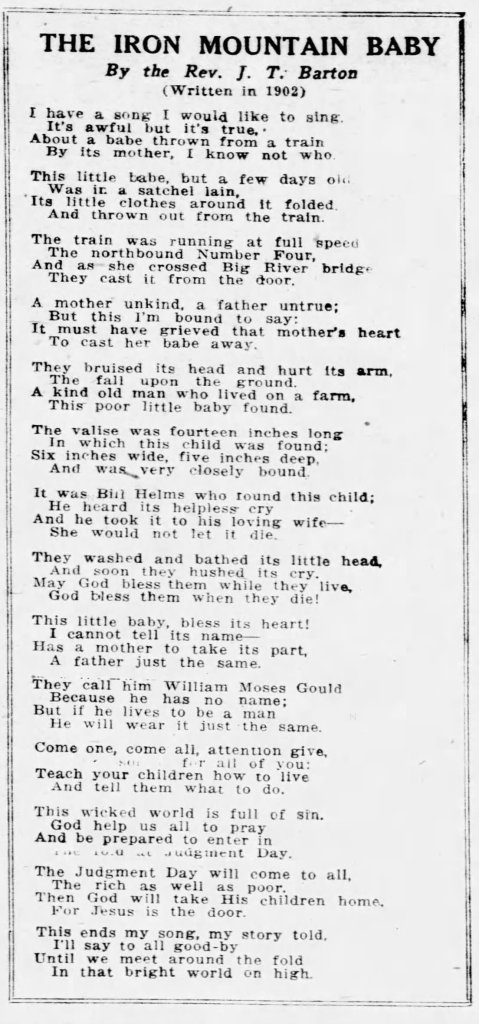
As it turns out, he didn’t need to look far. His friends had been whispering back and forth about a local story of interest that he thought he could make a song out of. Down the road in Salem, a little baby had been found on the railroad tracks, having been ignominiously stuffed into a suitcase and pitched out the window of a moving train. Miraculously, the child survived! A local couple adopted the little one and gave it a home and family. Intrigued, J.T. decided he wanted to hear more, and set out to meet the child and get the story firsthand.
Verse 7
He wrote a song about a child
Who had been rescued from the wild
The song, a legend, filled his purse
But came with an ominous curse
Verse 8
An elder man, so bent and scarred
Gave him a stone smooth, gray, and hard
A heart that holds the Raven’s life
But a warning for the man and wife
A Folk Tale
J.T. arrived at the child’s house and was welcomed by a lively group of people. The adoptive parents were visiting with some local friends, but they gladly invited J.T. inside and sat him down with a cup of coffee so he could hear the tale. As they animatedly recounted the tale of the Iron Mountain Baby, J.T. listened intently but was becoming increasingly curious about a dark-eyed old man who had stayed in the kitchen to listen. The man had sat down on a milk stool by the table, and unlike the others, who were caught up in the storytelling, this man held his gaze on J.T., unblinkingly studying his face with a cautious sense of calm.
After a while, the family rose from the table. “We’re butchering hogs for dinner,” the father said. “But stay a while, and you can eat with us.” J.T. was happy to stay, and as he stood, the old man gestured to J.T., beckoning him outside. Curious, J.T. followed.
The man introduced himself. “I am a friend, called Atsadi by my family.” J.T. recognized it as an old Cherokee name, but couldn’t quite place its meaning. When asked, the old man answered, “Atsadi means fish, and I think you know something about fishing for men.” J.T. smiled, recognizing the reference to Matthew’s gospel, which he often used in his sermons. And he saith unto them, Follow me, and I will make you fishers of men. Atsadi was still talking. “I am no fisher, I am the fish. I observe the world from below the surface, and I see things others do not see.” J.T. was intrigued, and talked with Atsadi for a while. When J.T. shared that he, too, was partly Cherokee, Atsadi asked him to prove it. J.T. looked around to where the father was butchering hogs. He asked if he could have the hog’s kidneys, and then took coals from under the scalding vat and crafted an earthen oven to slow bake the kidneys upon, as he had learned to do in the old Cherokee way from his mother.
As they watched, they settled into an easy, friendly conversation, and Atsadi told J.T. about the Bear Dance, a dance with great symbolic importance. To perform the Bear Dance, one must imitate the movements of the animal in order to show respect and admiration. “I suppose,” Atsadi said with a glint of humor, “we could dance in honor of the hog tonight.” And so, as the kidneys cooked, the two men performed an impromptu dance around the fire. The sight of them dancing under the night sky with the flames flickering brightly would become a story passed down in the community for decades to come.
As J.T. prepared to leave the house and journey home, his new friend Atsadi pulled him aside. “I have a gift,” he said. Reaching into the worn satchel he carried, Atsadi produced a small stone and presented it to the Reverend. It was unlike any rock J.T. had seen before – oddly shaped, sort of oblong with a strange texture that felt ancient and unfamiliar. As he ran his fingers over the ridges and bumps that spread across the surface of the gray artifact, Atsadi spoke. “It’s a heart,” he explained. “A petrified organ, found long ago beneath the Penn Treaty Elm. Under that tree, William Penn made a promise to live in harmony with the Native people and respect our rights to the land we live on. The tree stood for a hundred and forty years, but one night, a storm took it down, and many artifacts were discovered buried beneath its roots. This stone has been in my possession for most of my life. It is said that it was once stolen from the Raven Mocker.” J.T. shuddered, remembering the tale his mother had told him of the witch who stole the lives of dying men by taking their hearts.
Atsadi pressed the stone into J.T.’s sweaty palm, holding his gaze steady. “I want to give you this, but I think I should warn you. The stone holder will experience much luck and good fortune. I think it should help you find success with your song. But keep the stone too long, and it becomes a curse. We aren’t meant to have endless luck and good fortune. The years that the Raven Mocker steals are the years at the end of a life, the sick and sorrowful years. Enjoy the fortune and then pass the stone along, or you may find your final years filled with loneliness.
J.T. felt the weight of the stone, heavy in his palm. He nodded solemnly. Though he believed in God and the stories of the bible, he also held the stories of the Cherokee people close to his heart. He knew that he was saved and destined for heaven, but he had no desire for the last years of his life to be full of hardship. He would put the stone with his other Cherokee artifacts and remember Atsadi’s words well.
Verse 9
The Iron Mountain Baby song
Was sung by many, loud and strong.
And J.T.’s fame was thus enshrined
In hearts and Halls of Fame combined.
Verse 10
He’d shared his stories far and near
But soon his heart was gripped by fear.
The shadows claimed his darling’s life,
And J.T. faced a world of strife.
Chorus
Oh, Brushy Creek, where Legends grow
Where faith and folklore ebb and flow
With potter’s clay you build them all
To follow their ancestors’ call
Goodbyes
Returning home from his visit, J.T. felt refreshed and inspired. That very night, he penned a fourteen-verse ballad about the Iron Mountain Baby. He sang it for friends and family, who took a liking to the tune and sang it to their friends. It caught on, as folk songs do, and eventually it caught the ear of folk singer Johnny Rion, who asked J.T. for permission to record it. Soon, it played on radio stations around Missouri, and was eventually placed in the archives of the Country Music Hall of Fame. The song traveled further than J.T. ever could have imagined, reaching people who had never even heard of the Ozark hills with their iron-rich mountains. J.T.’s legacy as a storyteller and songwriter was cemented, and he reveled humbly in the honor, grateful to see his worked cherished by so many.
With the modest income from song royalties, J.T. and Annie purchased a home of their own in St. Francois county – a solid house that cost him a thousand dollars. Friends and family from all over came to visit, filling the home with laughter, music, and the warmth of company all throughout the years. J.T. would play his guitar and show people his collection of Cherokee artifacts, enjoying the sounds of the next generation carrying on the spirit of the stories he loved.
But time was passing, and J.T. was mindful of the warning he’d received. He’d lived a long and blessed life, but time was taking its toll on his and Annie. His beloved wife, his faithful partner, grew weaker each day, her body eroded by diabetes and cancer of the liver. J.T. prayed fervently and asked his congregation for their support, but he knew that this would be a loss he could not escape. Annie passed away in 1938, leaving J.T. heartbroken and adrift.
The time that followed his wife’s passing was sorrowful. J.T.’s thoughts frequently returned to the petrified stone, and he knew that his luck had run out. One evening, he took the stone in his pocket and went for a walk on the edges of his land, down by the creek where he and Annie had once strolled together. He knelt by the water and prayed to God, thanking Him for the life he had been given and the many, many blessings he had enjoyed. With a whispered Amen, he let the stone fall from his hand, watching as it disappeared into the rippling water of the creek for good. J.T. felt a strange peace settle over him, as if he were finally closing a final chapter of his life.
It was 1939, less than a year later, that J.T. passed away at his sister Polly Ann’s home. Family and friends gathered from far and wide to celebrate his life, singing the little tunes he’d written and reminiscing on the sermons that had touched their hearts. J.T. had woven faith and folklore together masterfully, and carried bits of Cherokee and Ozark heritage with him wherever he went. And somewhere beneath the dense soil of that Missouri creek, the little petrified heart lay buried, a silent witness to a life lived with purpose that would echo through the generations to come.
Chorus
Oh, Brushy Creek, where Legends grow
Where faith and folklore ebb and flow
With potter’s clay you build them all
To follow their ancestors’ call
Coda: This story is embellished but based on actual stories passed down in the family and documents left behind in genealogical and historical archives. You can read more about this website here: About the Site
 My Kindred Chronicles
Leave a comment