
The Funeral
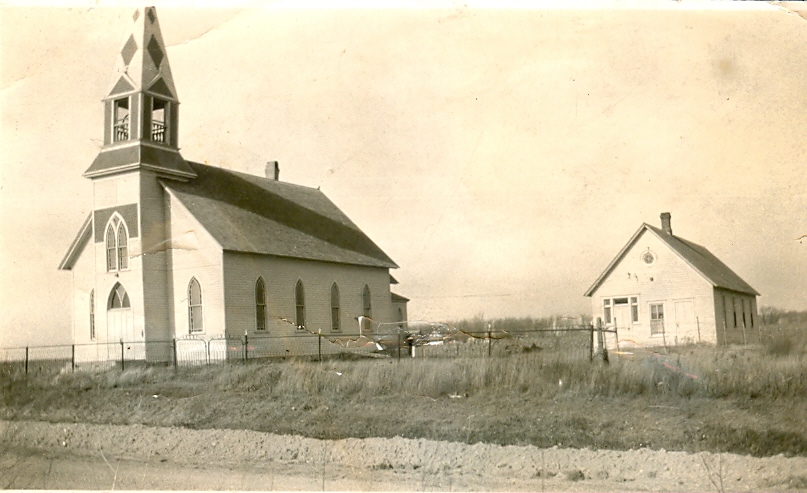
Photo credit: https://lostislandlutheranchurch.org/
The wooden steeple of the Lost Island Lutheran Church stood tall and steadfast despite the bitter cold and winds of the Iowa landscape. It was barely two days past Christmas, 1920, and the nativity creche was still set up near the altar. Despite the chilly cold of the sanctuary, the sun was shining hot into the windows and melting the snow outside. Carrie Bergum sat in the front pew, surrounded by what was left of her family – her husband Erick, her son Arthur, and her two remaining daughters Annie and Emma clutching her hands tightly, quietly tearful. Eight miles away, they later would bury Carrie’s daughter Alma at Valley View Cemetery. Alma was the third of Carrie’s children to die in less than ten years.
At the end of the pew, her son-in-law Herman quietly managed his two young children Stanford and Ruth, neither child yet even five years old. The heaviness of the event weighed her down, but she took a deep breath, filling her nose with the scent of the burning candles and fresh wax as Reverend Thorson directed the congregants to open their hymnals. The organ began to softly play a familiar hymn.
“Jeg er en gjest og fremmed, som mine fäder här” (I am a guest and stranger, like my father here)
Carrie’s voice trembled, her throat catching with emotion, but she sang along anyway, grateful for the words that were blessedly in the familiar Norwegian language. Just two years before, that snake of a governor had tried to strip them of using Norske in worship, declaring that “God is only listening to the English tongue.” The passing of that hateful Babel Resolution, even though it lasted only six months, had thrown the church into a crisis. Half of the congregation could not even yet speak English, many of them still new immigrants to the country. But in this church, their hymns still blessedly and defiantly used the language of “Old Norge” and the words brought Carrie so much comfort, which she was sorely in need of these days.
The organ grew louder and the voices parted in harmony, rising to fill the cavernous space of the beautiful church with its intricately carved wooden altar and benches. Members of her own family had done some of that work. She let her mind drift as the song continued.
“Mitt hem är ej på jorden, nej, ovan skyn det är”(My home is not on earth, no, it is in the sky).
Carrie thought about her daughters. Alma, now at rest, and Rose, lost only a year before. The two sisters had been so close. Rose’s death had come as a surprise to all of them and had broken Alma’s heart. And young Ella too, gone too soon. She struggled to fight the tears as she thought of the sisters reuniting in heaven – a celebration rather than the dirge she was sitting through now.
“Däruppe bor min Fader, i härlighet och ljus” (Up there my Father dwells, in glory and light). “Där ville jag ock vara, uti min Faders hus” (There I would also be, in my Father’s house).
The hymn came to an end and Carrie closed the dusty hymnal, listening to the collective shuffles as the Scandinavian collective surrounding her took their seats once again in the pews. This day was hard, unbelievably so, but Carrie had walked this road before, and she knew that loss was not an end, only another turn. With a steadying breath, she squeezed her children’s hands, wiped her tears, and lifted her head, ready for whatever the pastor would say next.
The War
In the mid-1800s, waves of Norwegian immigrants arrived in the midwestern states of America, seeking inexpensive land and the freedom to establish their own churches without government interference. In 1848, John and Julia Thorsness boarded the immigration ship Dorothea with their five children, embarking on a two month’s journey from Bergen, Norway, to New York. Though sad to leave behind the fjords and mountains, they were eager to pave their own path in the fertile farmland of Wisconsin. Once they arrived, the Thorsness family thrived, with five more children coming along in short order after they reached their new home and settled among other Norwegians, Swedes, Danes, and Germans; each group was seeking a new life together as Americans, and the Thorsnesses were proud to be there too.
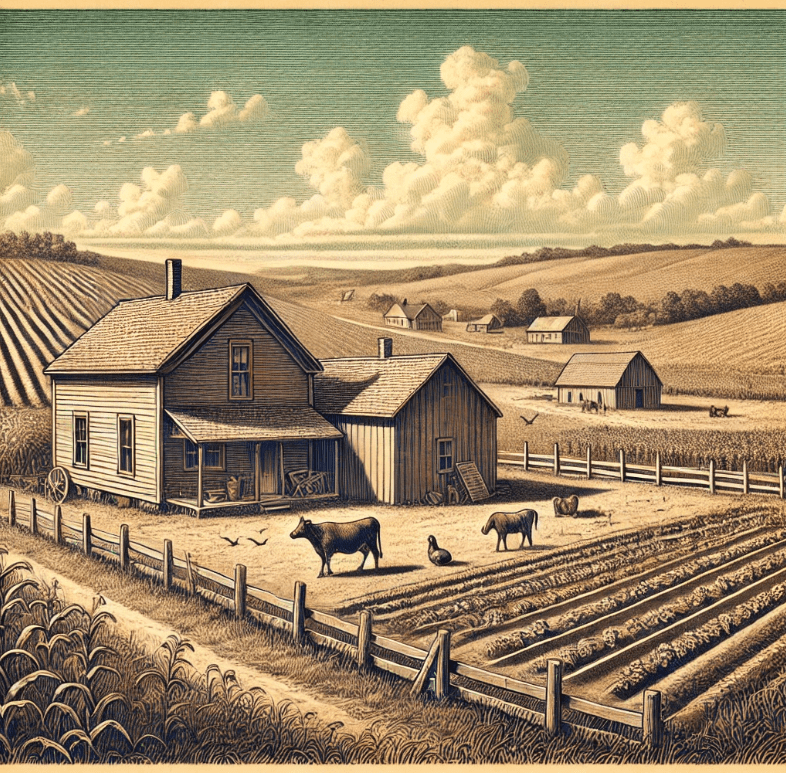
Carrie was the eighth child in the line of ten, born in April of 1854 into the vibrant immigrant community that was growing in Dane County, Wisconsin at the time. Deerfield was still a developing settlement, filled with immigrant farmers working to adapt to the American landscape, culture, and language. Life was a mixture of old and new, with Norwegian traditions blending with American ways. Carrie’s early life reflected this, her days filled with the rhythm of farm chores, visits to the Lutheran church, and gatherings with other Norwegian families.
Carrie felt a strong bond with her siblings, especially her oldest brothers Ole and Carl, who were hard-working and always protective of her. But the innocence of Carrie’s childhood was under threat, slowly giving way to the tensions of a nation on the brink of civil war. When Abraham Lincoln, the leader of the anti-slavery Republican party, won the 1860 election, seven southern states reacted with secession – leaving the Union and setting off a chain reaction that led to the bloodiest war in the history of America. As war loomed, the family’s quiet life became increasingly threatened, and the stability of what they were building began to feel fragile.
Carrie watched with anxiety as her two oldest brothers, Ole and Carl, began to argue with increasing intensity the key issues of the war with one another, the strain of divided loyalties threatening to shatter the family’s unity. Ole, who had been born out of wedlock, had always been a bit of a rebel – headstrong and defiant. His younger brother Carl, by contrast, was the grounded, steady one, and never let Ole forget that he was the eldest legitimate son. To Ole, rebellion seemed to come natural, and with the promise of freedom and the life of a soldier, and also somewhat as an insult to his brother, he joined the confederate army. To him, it was a chance for adventure, for proving himself as a man outside the obligations of his own family.
To Carl, it was an incomprehensible betrayal. The entire neighborhood had been buzzing with anti-slavery sentiment, and most Norwegians felt the desire to demonstrate brotherly magnanimity to anyone who wished to become an American citizen, including the enslaved. The war was a struggle to preserve a nation built on freedom and opportunity, and most Scandinavians joined the military as union soldiers if they enlisted. “This land we’ve come to,” Carl had once said to Ole, “represents something bigger. Slavery is wrong – it wasn’t allowed in Norway and it shouldn’t be allowed here.” Carrie, only ten years old, was too young to fully grasp the nuances of the debate, but she was old enough to feel the tension. She was sad when Ole left, but sorrow turned quickly to fear when Carl, too, signed up to join the war – on the opposite side as Ole. She sensed that no good would come of this.
Carrie would remember for the rest of her life the day she learned that Ole had died. A stranger came to the house with the news – a man who had fought alongside Ole in the weeks leading up to his death. The Thorsness family reeled in the tragedy of it. Her brother had died so far from home. He had come four thousand miles to a new land, braving stormy seas and breaking his back to make the Wisconsin farmland into a home for the family, only to die alone on a battlefield, fighting for a cause that was everything they despised. She clutched her mother’s skirts and sobbed, not understanding how the world could be so unfair. Julia could only hold her daughter and whisper words of comfort. “Kjære lille – little one – we don’t always know why God takes the ones He does, but we must trust He has a reason.” In difficult times, the family always leaned on each other. Carrie would be all right.
And she was. It was only a few months later when her brother Carl returned home, a day of both pride and sorrow. Mostly, it was a happy homecoming – he had been promoted several times in his short run within the military and returned as a hero. His homecoming was bittersweet, but with it came healing, his service a point of pride for the family. Carrie asked him questions relentlessly, admiring the strength and endurance that had allowed him to carry on during the darkest days of the war. I’m going to be strong like Carl, she thought to herself, and set her mind to the task. The war had cost her a brother, but it had brought another back, and she would learn the lessons Carl could teach her and carry them with her throughout her life.
Wins and Losses
As Carrie grew, she watched as her siblings gradually moved away from Wisconsin, one by one, to forge their own lives in Minnesota, South Dakota, Iowa—anywhere with open land and opportunity. When her sister Sylvia moved to Lincoln, Minnesota, to start a family with her husband John, Carrie went with her. Living with Sylvia and John was a young boarder named Erick Bergum, a farmer whose parents had also come from Norway. She and Erick got along like a house on fire. Meeting him felt like finding solid ground after a long journey, and they were soon wed. The following years were happy as they moved from South Dakota to Iowa, trying to determine which place felt most like “home.” Eventually, with the birth of their youngest child Arthur, they settled near Estherville, Iowa, on a farm Erick purchased west of Graettinger. Thirty friends and neighbors surprised them with a warm homecoming party, bringing food and gifts, including a fine set of silver knives and forks as a welcome to their new home.

Motherhood had given Carrie purpose and a sense of calm, the rhythm of days spent cooking, cleaning, and instilling good Lutheran values in her family. Yet, raising her children made her miss her own mother, who had died while Carrie was still pregnant with one of her five beautiful daughters. The knowledge that Julia had never seen the life Carrie had built filled her with a deep sadness. To cope, she poured herself into her family, finding solace in their daily routines and remembering her resolve to be strong, just like her brother Carl. He had moved to South Dakota, but they stayed close, writing letters to one another every week.
Then, at only 45, Carrie faced a devastating loss when Carl passed away, his body finally succumbing to the toll the war had taken on him. To add insult to injury, shortly after Carl’s death, her father died, and then another brother. These deaths were painful reminders of life’s impermanence, and Carrie found herself struggling with the strength she had promised to keep inside. She had so many siblings—not to mention nieces, nephews, and her own children—how many more would she have to mourn before her own time came? Why did life and death have to be such mysteries? Though she didn’t dare question God or His grand plan, these thoughts haunted her, bringing an unease that she could not easily shake.
But life carried on, and just as she always had, Carrie found resilience in her role as a mother. She poured her focus into her children, teaching them to read, write, and speak English, preparing them for a successful life in America. In them, she found both hope and purpose, her way forward amid a life marked by ecstatic love and incomprehensible loss.
Devastation
The years passed, and Carrie delighted in her family. By 1902, her children ranged from ages six to twenty-one, each bringing their own distinct joy. Her eldest, Ella, was studying to be a grammar teacher, a career path that already held interest for her younger sisters, Emma, Alma, Annie, and Rose. Carrie felt immense pride in her daughters, who loved books and learning. Fourteen-year-old Annie sometimes held mock lessons for the family, teaching them about far-off places like Peru or giving cooking lessons, with little Arthur sitting attentively, as if he were her student.
When Carrie announced they would host the largest Fourth of July gathering their community had ever seen, excitement rippled through the household. Each child prepared a performance, and as fireworks lit up the sky that evening, Carrie thought to herself that life was perfect.

The rosy glow of that life lasted for some years, as the girls went to college and began teaching, just as expected. Arthur dabbled in various trades, even the stock market, before settling into a career with the postal service. But in 1913, when Ella was only thirty-one, she died suddenly after a brief stay in the hospital. “Subacute bacillary dysentery,” the doctor said, but the words meant little to Carrie. All she knew was that Ella, her precious daughter, had gone in for a surgery, struggled to breathe afterward, and had slipped away from her forever.
Carrie was devastated, but she tried to focus on her remaining children, determined to be the strong presence she had needed after her own sibling’s death. She steeled herself, pouring her grief into her daily routines and drawing strength from her faith. Slowly, the sting of Ella’s death dulled, and Carrie began to feel she could find peace again.
But then Rose died too. Away at teachers’ college, Rose had gone in for a nasal operation to relieve chronic sinus issues in early November. She never emerged from surgery alive. A letter from the college president brought the devastating news, and Carrie stood in the family room, holding the note in shaking hands. Rose had always been special to her—a child with her father’s quiet determination and her mother’s compassion. She was so full of promise, with so much life left to live. But, like Ella, she was taken so suddenly, and Carrie’s spirit trembled under the weight of it all.
Alma, a young mother now, who had been so close to her sisters Ella and Rose, was hit particularly hard. She had recently moved back to Iowa, eager to teach in the Estherville schools alongside her family. Even after Ella’s passing, Alma held onto a dream of teaching with her sisters, raising their families nearby, and growing old together. Rose’s death deflated that dream, and when Alma became ill, she couldn’t find the strength to fight it. Only a year after Rose died, Alma was admitted to the hospital as her condition worsened. Her husband, Herman, insisted on taking her to a hospital in Chicago, believing the advanced facilities there would offer the best chance at recovery.
It wasn’t enough. Two days before Christmas, Alma joined her two sisters, dying in that Chicago hospital after complications from surgery. Carrie felt as though a piece of her soul had died with each of her daughters. The grief was bottomless, a hollow ache that seemed beyond healing. The life she had once built now felt emptied of so much of what she held dear.
Now, as she stood by Alma’s graveside that cold December day in 1920, she clutched Arthur and Emma’s hands, watching as the casket was lowered into the ground at Valley View Cemetery. Her blue eyes, filled with tears, swept over the scene: Herman and Erick leaned against Herman’s Chevrolet 490, smoking pipes; Annie was minding Herman’s children, Stanford and Ruth. Herman caught Carrie’s eye, motioning for her to come speak with him.
As she approached, she noted the weariness in Herman’s face, his usual composure weighted down by sorrow. He had once been described in a rival’s newspaper as “effeminate,” but Carrie saw only a good man—a strong jaw, a steady hand, a dedicated husband and father. He had built a successful career in the newspaper business, even making it work across state lines when Alma had begged him to move back to Iowa. Carrie sighed, wondering what words of comfort she could offer.
When she reached him, Herman extinguished his pipe and stowed it away in the car. “How are you doing, Mor?” he asked, using the affectionate Norwegian term for mother.
“Oh, Herman,” Carrie said, her voice soft. “It is all so sad. I feel so sorry for Alma’s little children.” She looked over to where Annie was holding Stanford and Ruth’s hands, guiding them along the small walking path by the gravesite. “You must lean on Annie and Emma now for help with the babies.”
Herman nodded, but it was clear he had more to say. Finally, a single icy tear escaped, clinging to his eyelashes in the cold. “How do I go on?” he whispered, his voice breaking. “This… this feels unbearable. Alma and I did everything together. I don’t know if I can live without her.” He lowered his face into his hands, rubbing as if he could scrub away the pain.
Carrie felt her own sorrow mirrored in his words. She placed a steady hand on his shoulder. “We carry on by clinging to what we have left, Herman. To family, to the ones who are still here,” she said firmly, her voice steady. “You must live for Stanford and Ruth. They need you now more than ever.”
Herman glanced over at his children, watching them walk with Annie. “I know it feels impossible,” she continued, her voice filled with gentle resolve. “But each day, we rise. Each day, we honor those we’ve lost by loving those still with us. Alma may be gone, but we carry them her us in our hearts.”
Her words resonated within her, bolstering her spirit. She would return home, as she always did after visiting that lonely cemetery, to sit with her family. Neighbors had brought food, and she would eat alongside them, ruefully remembering those who had passed. Her grandchildren would clamber onto her lap, and when she put them to bed that night, she would thank God that there was still a plan and purpose for them. She found her strength, as she always had, in her family.
A Guest and a Stranger
The old hymnal had a dusty smell, but Carrie smiled as her bony fingers, arthritic from 75 years of hard work, turned the pages. The organ sounded beautiful in the newly-renovated chapel, and her voice lifted with the harmonies of her favorite hymn, Jag är en gäst och främling—I am a Guest and a Stranger. Her voice was strong as she sang the familiar words.
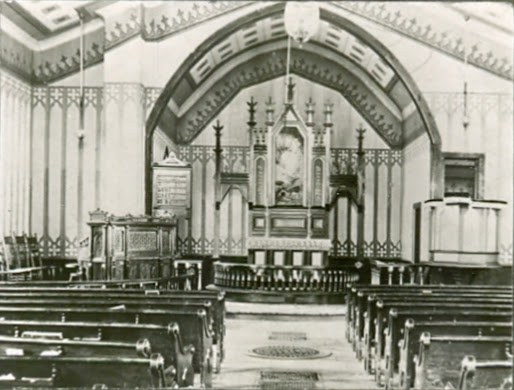
Photo credit: https://lostislandlutheranchurch.org/
“Vårt rätta urhem, det är ej på jorden,” Our rightful home, it is not on earth
“Här bo vi blott en liten, liten tid,” Here we live only for a short, short time
“Hos Gud en bättre boning vår är vorden,” With God, our better home is the future
“När här vi slutat livets korta strid.” When here we have ended life’s short struggle
Carrie felt the reassuring presence of Erick beside her in the pew and reflected on the life she had lived. Breathing steadily, she offered a silent prayer of gratitude for each family member who had blessed her life. More losses had come and gone since her daughters had passed, but now, it brought her a sense of peace rather than sorrow. The journey from her childhood as one of an immigrant family to the role of a matriarch of her own had tested her in every conceivable way. She had witnessed war, endured heartbreak, and now in her later years, she was faced with the trials of a weakening body. But through every hardship, Carrie had somehow managed always to find her strength—a strength she had learned at such a young age, honed through faith, family, and resilience.
As she exited the church that day, a gentle peace settled over her. Her steps were slow but steady, her heart bearing the weight of her years with quiet grace. As she made her way back home, she carried within her the calm knowledge that she had been, above all, a survivor, a mother, and a keeper of her family’s stories—a life lived with purpose, and a legacy that would echo for generations to come.
Coda: This story is embellished but based on actual stories passed down in the family and documents left behind in genealogical and historical archives. You can read more about this website here: About the Site
Credit to Linda Sandell for the hymn lyrics: more here
 My Kindred Chronicles
Leave a comment