
The Mitchell Home in Decatur, Wisconsin, date unknown
Family Gathering
Abner’s cane made a satisfying crunching sound as he walked over the tough Wisconsin dirt of his homestead, squinting so he could better see the buggy approaching the gravel path. His eyesight had been failing him in the last few years, but he could still manage to get around. He rested his hand on the tough brick of the house so that he would not stumble as he stepped out onto the path – he had once been sturdy enough to hew thick timber, but now his body trembled with age. The large brick house, situated on a broad tract of farmland in Southern Wisconsin, was a testament to the wealth he had built for his family – each brick held the hope for a secure future for his children and grandchildren, for generations to come. Abner often sat on the porch and watched the fields, remembering the decades of plowing and working the land to build something meaningful. Those memories stirred as he watched the horizon – multiple buggies now, and the soft strains of laughter and voices breaking into the evening.
The fruits of his legacy were arriving now, a caravan of carriages with children tumbling out, their laughter breaking into the quiet of the evening. His own children, now almost all elderly men and women themselves, carried baskets of food and gifts for the celebration. It was October 8th, 1874 – his 84th birthday – and he had gathered his entire family together for the occasion. He smiled softly, contemplating the evening ahead. There was much to be said, and he wasn’t sure if the ache in his heart was from age or the conversation ahead. He wasn’t sure how much time he had, but he knew he had to get on with it. He turned and headed into the parlor.
Inside, the house was warm and lit brightly from the fire in the hearth. Abner’s daughter Louise, who lived with him and helped keep the home running, flitted from room to room, making sure the kerosene lamps were lit and that everything was tidy for company. Abner took his seat by the fire, gazing out of the window at the arriving family, the first of whom was already coming through to join him – his daughter Cynthia, accompanied by her husband and a few of her children. Abner’s grandson Owen was with her too, though he was his eldest, Jesse’s, son. Owen had been living with his Aunt for a while now. Even when relations got complicated, the Mitchells always stuck together. Abner was proud of that, and hoped he could convince the children to carry on that legacy.
Cynthia called cheerfully to Abner as she came through the entryway, undoing the ties of her bonnet. “Father, the cavalry has arrived!” She patted her skirts firmly to shake out the dust of the road and took a seat near Abner by the fire. Abner smiled faintly. He had always admired Cynthia’s spirit.
“It’s about time,” he quipped. “I was wondering if the cows would come home before all of you got here.” He grinned at her, but his smile faded as he noticed his oldest son Jesse hovering at the doorway, with young Frank in tow. Frank, Jesse’s fourth son by his second wife, was ambitious in a way that made Abner nervous. He watched as Frank looked greedily at the pile of deeds and papers stacked on the secretary desk in the corner. Abner sighed. The estate was large enough for everyone to have a share, but he worried about the greed that had taken hold of some of his grandchildren. He’d wanted to leave his children a legacy, not a battleground.
Jesse broke the tension by clapping some of his arriving siblings on the backs as they, too, entered and took their seats. “Father, you didn’t mention we were having a council meeting tonight!”
Abner shook his head, clearing his thoughts. “No council. Just supper. And a celebration, I hope! 84 years has given me a lot to be grateful for.”
Jesse tipped his chin at his father. “And let me guess. This is your last birthday, right?” All of the siblings chuckled at that. Abner had been predicting his demise for years. Every year, he’d told them this might be his last birthday, and every year they’d laughed it off. It had become something of an inside joke with the family.
Louise entered the parlor with a steaming pot of coffee, greeting everyone warmly and doffing her apron. “Everyone’s here to celebrate, so why don’t we cheers to our honorable father?” The tension broke as everyone took a cup and the children gathered near the fire, playing with some toys while the adults settled into their seats for the evening. Abner looked around the room. “I’ve asked you all here because I have some stories to tell. And before the night is over, perhaps some truths to reveal.” He glanced at the mantel clock. “Not much time now, so let’s begin.”

The War of 1812
Abner leaned back in his chair, his withered hands gripping the arms as if to steel himself for the weight of the memories that were coming back to him. The room quieted, and Abner surveyed the room, his eyes lighting one at a time on each of his living children – now grown, gray and faces lined with age, yet eager still to hear these stories he had spent decades reciting. Jesse, Cynthia, and Louise were there, but also Benjamin, Joseph, Washington – and there was Judson, sitting on a stool in the corner, his back ramrod straight, the posture of a soldier unmistakable. Abner’s chest swelled with pride for Judson, a civil war hero who had been among the first to enter Atlanta and raise the flag of the Union. Judson’s little ones were playing by the fire, and Abner remembered how it had felt listening to his own father, Captain James Mitchell, tell stories of the revolutionary war.
“I want to take you all back,” Abner said at last, his voice carrying the deliberate cadence of a seasoned storyteller, “to the War of 1812. I was just a young man of twenty-two, a newlywed with a young wife – your mother Hannah, to look after, and yet…” he paused, letting the anticipation build. “The world felt like it was on fire.” Everyone held their breath, waiting for the story to continue.
The crackling fire in the parlor faded into the sounds of distant gunfire and the steady thrapp-thrapp of a drum. The regiment of militia men lined up on the cold Pennsylvania soil, their breaths puffing frosty clouds into the morning air. Young Abner, enamored with his father’s tales of the Revolution, had longed for the chance to make his own mark in service of his country. As Quartermaster Sergeant of the 2nd Regiment of the Pennsylvania Militia, he’d found his opportunity. Each day, he took inventory of arms and supplies, and each evening, he rallied the men, ensuring they were prepared to hold the line against the British—or even Tecumseh’s confederacy, if it came to that.
“I was just a farm boy then,” Abner recited, his voice steady as he addressed his family. “We’d heard whispers of war for months, but I wasn’t sure it would actually happen. America had never declared war before. But when the British cut off trade to France, I knew it was coming. Sure enough, the call went out, and I joined up. Your mother, Hannah, was beside herself—pregnant with Jesse over there—but I had to go. I had to make the Mitchell family proud.”
Jesse straightened a bit, his face brightening at the mention of his name, but it was Judson who leaned forward, his posture rigid, his knuckles white on the chair’s edge. “What was it like then?” Judson asked, his voice measured but tight. Abner could see the weight of his own wartime memories etched into his son’s face—memories of raising the Union flag in Atlanta and of all those harrowing days, wasting away in a Confederate prison.
Abner reached out, resting a reassuring hand on Judson’s arm. “It was terrifying,” he said softly. “And exhilarating. My regiment learned every word of that new song about the star-spangled banner, and we sang it proudly. But not until after we made it home safely.” His voice trailed off, and his mind drifted. He could feel the rough stone of the walls beneath his fingers, the muskets heavy in his trembling hands. The chaos of battle. The screams of the wounded. The fire of glory, snuffed out by the reality of blood and loss.
Abner exhaled and returned to the present, glancing at Judson, who was staring into the fire, lost in his own thoughts. “That’s where I learned the value of building something,” Abner said, his tone deliberate. “Wars are for tearing things down. It’s what we do after the dust clears that matters—standing our ground, rebuilding what we can. That’s what I’ve tried to do for all of you.”
Jesse’s voice broke the silence. “Is that why you left Pennsylvania? To start fresh?”
Abner nodded slowly, a faint smile tugging at his lips. “Wisconsin held so much promise. After the war, I figured if I could organize soldiers and muskets, I could organize farmers and horses just as well.” He chuckled. “And the land was dirt cheap.”
The mood in the room shifted. Frank, one of Jesse’s younger sons, perked up at the remark, his eyes narrowing as if calculating something. “Yeah,” Frank said, the edge of his tone cutting through the warmth of the parlor. “But it’s worth a hell of a lot more now, isn’t it?”
The tension in the room was palpable. Jesse frowned at his son, but it was too late. Abner’s sharp gaze landed on Frank, his voice low and firm. “We’re here to celebrate, Frank. Not to quibble over inheritance.”
Frank shrank back, and the room fell quiet once more. The fire crackled, casting shadows on the faces of Abner’s descendants as they waited for him to continue. Abner glanced at the mantel clock, its rhythmic ticking grounding him in the present. “Now,” he said, gesturing to Louise. “I think we ought to go continue the story at the supper table.”

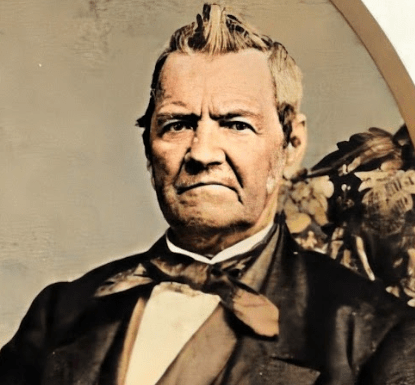
Abner Mitchell, unknown date
Pioneering
After dinner, Louise and her sister Cynthia gathered the children for bed as the adults resumed their places around the fire. Little Louise, who they all called Kitty, protested. “Oh Auntie, couldn’t I please stay up and listen?” Kitty loved her grandfather’s stories. But it was getting late, and the men often got loud with arguments as these nights went on, so it was off to bed regardless. Abner was wistful, thinking of the many evenings spent with Hannah and his children when they were young. He missed those days.
“After the war, I came home to Wharton,” Abner began his story again when everyone was settled, lowering his voice a notch for the childrens’ sake. “Your mother and I built a life there, on that same land I had worked as a boy. It wasn’t easy work, but it was honest. The farm was a modest size. A little corn. A little wheat. And soon the children started coming. There were thirteen of you! It hardly seems real that ten of my children would have lived so long as to see my 84th birthday, but here you are.” Naomi reached over and squeezed Ralph’s hand.
“But the farm wasn’t our only job. Our family had the responsibility to the church, and we built one of the first Baptist churches in the region – Little Kentucky Baptist Church. I still remember those early meetings – your Uncle James and I would gather around with the neighbors in homes, or in schoolhouses, and we would sing old hymns and preach for hours. I think it was around the thirties when we finally got it organized. I was the first official clerk for that church,” Abner declared proudly.
Franklin jumped into the conversation now, happy to be on solid footing. He was a deacon and trustee of the Baptist Church in Juda, Wisconsin, and could talk about church business all night if given half a chance. “Did you preach too, father? What were your sermons?”
“A little,” Abner admitted humbly, “but preaching was more of your uncle James’ calling. He had the voice for it, and he could command a room! But I did my part in the church too, collecting offerings, keeping records, and when it came time to build the church at Falls City, I was proud to help lay its foundation. I think that was, what, 1837?” His gaze shifted to the papers in the corner, documents that recorded the facts of his life. His journals were in that stack, and deeds to the lands he owned in Wisconsin. A few weeks ago, he’d added his last will and testament to the pile. Abner sighed. With thoughts of his farm, he returned to his story.
“Times were changing in Fayette county. It was getting crowded, and the opportunities weren’t what they once were. I started hearing stories about the land out in Wisconsin territory. Vast stretches of untamed land just waiting to be claimed – it wasn’t an easy decision to leave, but I knew it was right. So around, oh, 1840, we packed up what he had to come out here. Your mother was sorely upset with me, leaving behind her family. But she was strong. I loved her and every mile of that journey I prayed I wasn’t making a mistake.”
Louise, who never could sit still, stood up and started collecting mugs. Abner watched her with a fatherly, gentle love in his eyes as she moved about the room. When she reached down to take his cup, he carefully but firmly grabbed her arm, encouraging her wordlessly to sit down and relax. She settled in reluctantly.
“Your mother was pregnant with young Hannah when we came, did you know? It was meant to be twins, but we lost little Alexander right after he was born. She always blamed the stress of the move for that.” Abner shook his head, remembering. “And when we arrived here, well,” Abner hesitated, the memories difficult to master. “It was nothing here but wilderness. Wild animals, and some Natives. The first thing I did was stake a claim – Uncle Sam would sell me 80 acres of the finest land I’d ever seen, under some Land Act or other, and it cost me next to nothing. But the bargain came with work – clearing trees, plowing fields, building houses – it was a legacy in the making, and we worked hard at it for decades.” Frank, sitting near the corner, raised an eyebrow but said nothing, though his interest in the family’s land was clear.
Abner noticed and sighed, his gaze lingering on the burning logs in the fire. As the wood turned to ash, his voice softened with something like finality. “You know,” he said, almost to himself. “When you spend so long building something, you start to wonder if it will be worth it – if it will outlive you. If the land you build will carry all of the promise it held wild you were working it.” He looked again at the desk, with its deeds and journals, and then looked deliberately at his oldest son Jesse. “I’ve done my part to leave this family with a foundation, but the land isn’t what’s important.”
Frank looked alarmed. With all of the brashness of a young man of 18, he tried to take command of the conversation. “What do you mean it’s not important? This land is valuable! And there are so many of us grandchildren. How will it be split up, grandfather?”
Jesse shushed his son, embarrassed, but Abner stilled him with a wave of his hand. “No, it’s all right. I should have been more clear about the business of the farm before now. 84 years was too long to wait to talk about it.” He looked directly at Frank now. “But I want you to understand something about this land,” he said firmly. He looked pointedly at each family member in the room as he continued, “it’s all of you who carry the legacy onward. The land isn’t the important part. It’s the family. That’s the part that matters.” His words were a sermon, heavy with meaning, and for a moment, the room crackled with the weight of them.
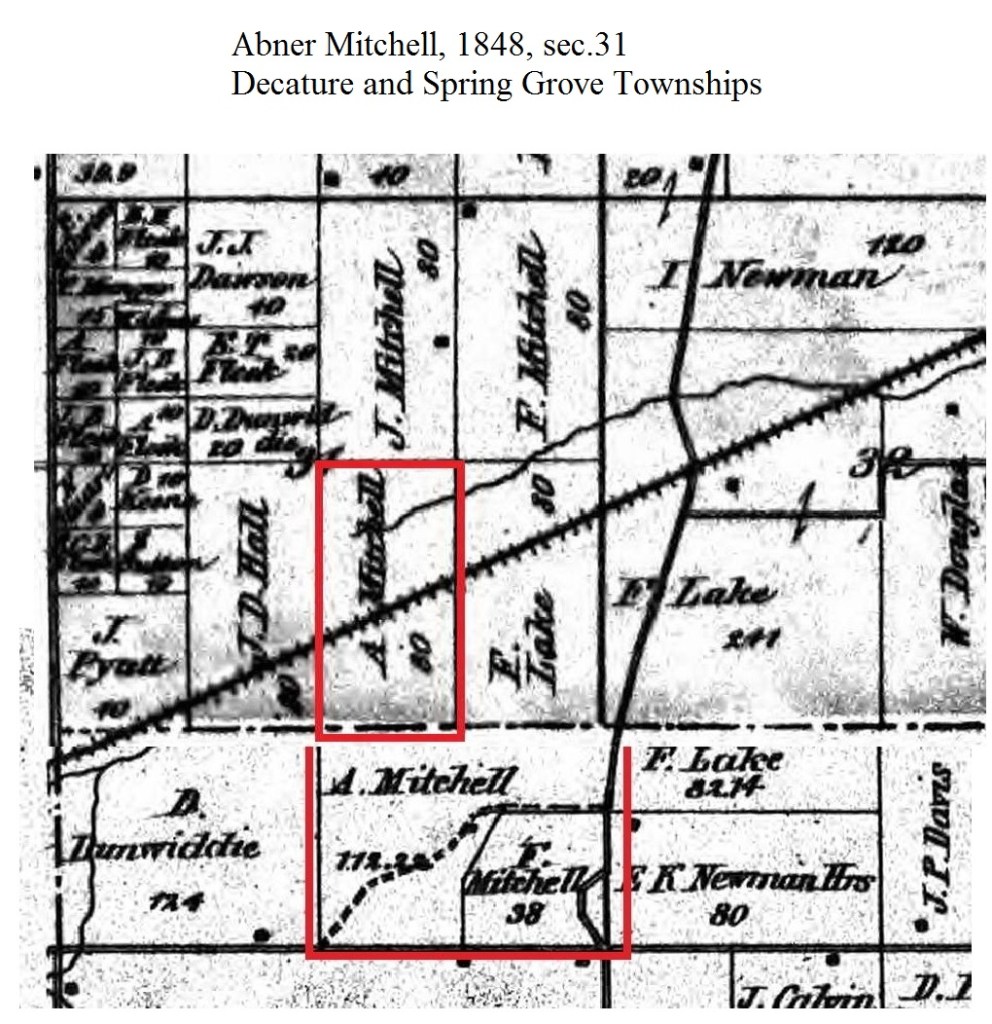
Abner’s land, acquired in 1848, split between the SW corner of Decatur and NW of Spring Grove.
The Final Hour
The reading of the will was done, and the papers returned to their place on the desk. Abner stood and turned towards the mantle, as if to view the old clock, its pendulum ticking a slow, steady rhythm. As he rose, he stumbled, and Louise rushed to help him. “Father, you need to rest,” she urged, but he just shook his head and grasped the back of his chair to steady himself, his gaze fixed on the clock.
“The hour has not yet come,” he whispered. “I have one more tale to tell.” The family watched warily as he eased himself back onto his chair, breathing a collective sigh of relief as he settled in safely. Jesse’s eyebrows furrowed. Did Abner look a little pale? Was his breath a bit labored? He watched his father as he reached with trembling hands for the glass of water offered him by Louise.
His thirst satiated, Abner continued his tale. “Farms don’t run themselves,” he said. “There came a time when this land we had fought to build needed a voice. We needed laws and support to run things, and I was already known as someone who wasn’t shy about public speaking. That’s how I found myself elected to the General Assembly.” Jesse looked impressed. “Our committee was the one that started the Wisconsin State Agricultural Society, did you know that?” He let out a faint chuckle. “A farmer in politics. Who would have thought?”
Benjamin caught his father’s glance. “Was it true that you helped bring railroads here? Or was that just talk?”
Abner’s lips quirked into a faint smile. “It wasn’t just talk. It was a fight. Every town wanted that rail line, and we had to argue why Spring Grove would benefit from it more than any other place. I remember standing in front of men from Green Bay, from Milwaukee, all with their fancy suits and big ideas. But I thought for a long time about how I could sell it, and in the end I just told them the truth—that the farmers here could feed the workers in their cities, that this land would thrive if given a chance. We got that line through to Juda in the end. Took years, but it was worth it.”
He paused, his hand briefly going to his chest as if assessing some concerning feeling. Louise hovered nearby, her face drawn with worry, but Abner waved her off. “I have to get through these stories, Louise.” His face was betraying a sense of urgency she hadn’t noticed before.
Naomi spoke then, her voice gentle. “You must have been proud, Father. To fight for something so important.”
The family was silent now, the weight of his words settling over them. The firelight flickered over Abner’s face, casting shadows in the deep lines of his age. He reached for his mug, his voice faltering as he continued. “This country… this family… they’re both built on the same foundation: hard work, faith, and the strength to face what comes next.”
His breaths were shallow now, and Louise knelt by his side, clutching his hand. “Father, please—”
Abner smiled faintly, his eyes distant, as if seeing something far beyond the room. “The hour… it’s almost here,” he whispered. He sank back into his chair, his gaze lingering on the old clock, now ticking closer to midnight. “There are so many more stories to tell, but I don’t think I have the time.”
Jesse was alarmed now, thinking of Abner’s prediction that he would die on his birthday. Was this really happening? He searched the faces in the room and saw the same question etched on everyone else’s face. The family held their breath, the room still except for the steady rhythm of the clock. And then it struck: one… two… three… the chimes echoing through the parlor. At the twelfth chime, Abner’s eyes closed softly, his hand slipping from Louise’s grip.
The silence that followed was heavy with the finality of the moment. Outside, the wind stirred the autumn leaves, as if whispering the story of a man whose life had carved its mark on both earth and heart—a legacy rooted in faith, family, and the enduring strength of the land he loved, which now passed into the hands of his loving children.
Coda: This story is embellished but based on actual stories passed down in the family and documents left behind in genealogical and historical archives. You can read more about this website here: About the Site
 My Kindred Chronicles
Leave a comment